Do not hesitage to give us a call. We are an expert team and we are happy to talk to you.
+212 712-833010
Miragemoroccotravel@gmail.com
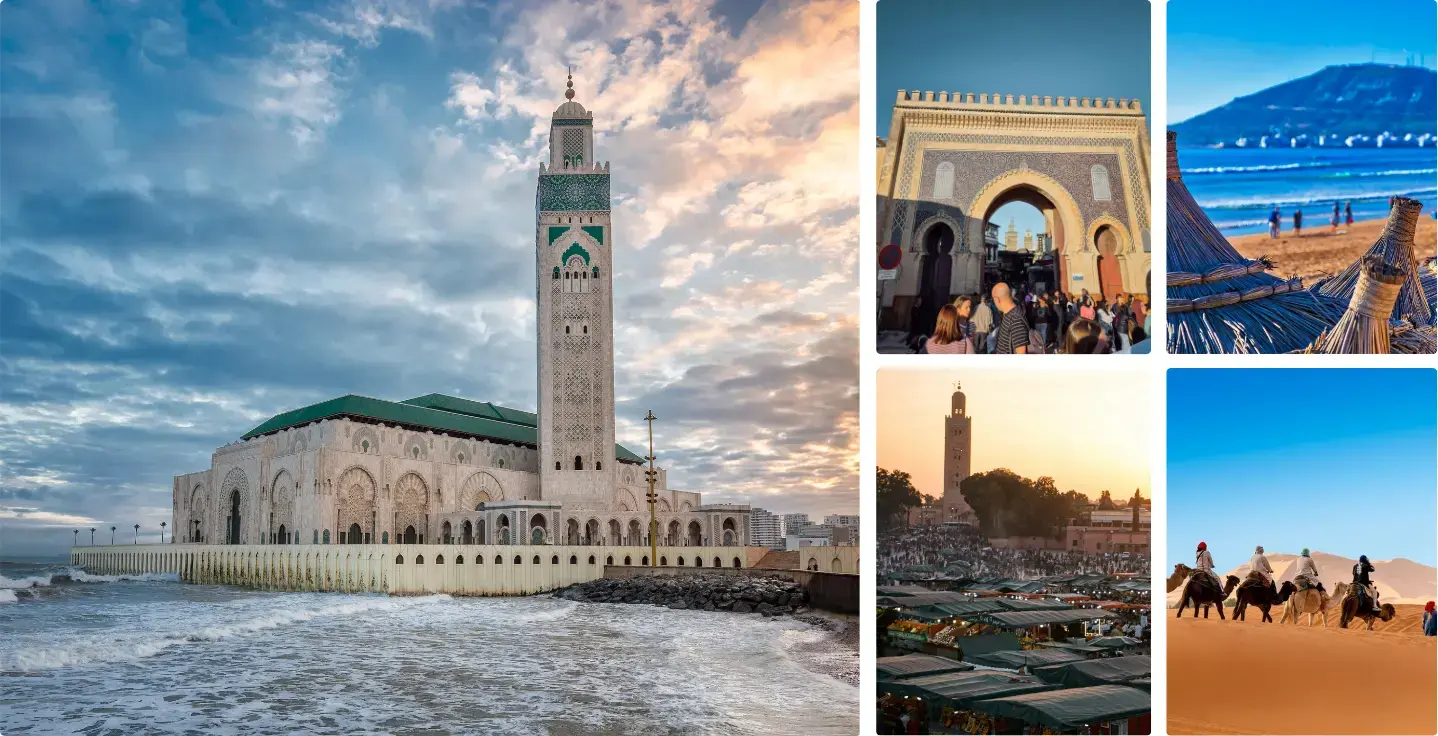
Experience the ultimate 15 Days Grand Tour of Morocco, a journey through ancient cities, cultural heritage, desert landscapes, mountains, and coastal gems. Begin in Casablanca, Morocco’s economic hub, and travel to the imperial cities of Rabat, Fes, Meknes, where you’ll explore UNESCO World Heritage medinas, historic monuments, and Roman ruins.
Traverse the Middle Atlas Mountains and the pre-Saharan plateaus, reaching the stunning Erg Chebbi dunes of Merzouga, where you’ll experience camel rides, desert camps, nomadic life, and breathtaking sunsets. Discover the dramatic Todra Gorges, Dades Valley, and the Road of 1000 Kasbahs, home to traditional Berber communities and rose-producing valleys.
Visit the historic kasbahs of Ouarzazate and Ait Ben Haddou, Morocco’s Hollywood of Africa, then travel to the coastal cities of Agadir and Essaouira, known for beaches, seafood, windsurfing, art, and Gnaoua music festivals. End the journey in the vibrant Red City of Marrakech, exploring Djemaa el Fna, Koutoubia Mosque, bustling souks, medina streets, and Moroccan traditions.
This 15 days grand tour combines history, culture, nature, and adventure, offering an immersive Moroccan experience from deserts to mountains, imperial cities to Atlantic coastlines, with authentic encounters with Berber communities and local traditions.
Upon arrival in Casablanca, the country’s largest city, you will be welcomed and transferred to your hotel. Depending on your arrival time, you may have the opportunity to relax or enjoy a first glimpse of the city.
Leaving Casablanca, the economic capital of Morocco, you will travel to Rabat, the country’s administrative capital. Here, you will visit the Kasbah of Oudaya, known for its charming Andalusian gardens and its strategic location overlooking the Bou Regreg River. Built during the Almohad dynasty in the 12th century, this historic site offers a peaceful atmosphere and beautiful views.
You will also explore the Mausoleum of Mohammed V, an architectural masterpiece that houses the tombs of King Mohammed V and his sons, and admire the iconic Hassan Tower, the minaret of an unfinished mosque dating back to 1195, intended to be the largest of its time.
After completing your sightseeing in Rabat, continue your journey toward Fes via the highway. Along the way, enjoy the scenic landscapes filled with vast olive groves and open fields stretching on both sides of the road. Upon arrival in Fes, you will check into your hotel for dinner and an overnight stay.
Today, we begin another fascinating adventure in Fes, the intellectual and spiritual capital of Morocco, often referred to as the “Mecca of the West” and the cultural heart of North Africa. As one of the four imperial cities, Fes is rich in history, tradition, and authentic Moroccan heritage.
The city is divided into three main parts. Fes el-Bali, the oldest section, is a UNESCO World Heritage Site and home to the largest medina in the world. Surrounded by ancient walls, it contains more than 9,000 narrow streets and alleys, forming a unique maze where life has remained unchanged for centuries. Within this historic medina, you will discover traditional souks, artisan workshops, mosques, and fountains that reflect the city’s deep cultural roots.
Fes el-Jadid is the newer historic district, where you will find the Mellah, the old Jewish Quarter, known for its distinctive architecture and historical significance. The third part, Ville Nouvelle, was developed during the French protectorate and offers a modern contrast with wide avenues, cafés, and contemporary buildings.
During your visit, you will also learn about the University of Al-Qarawiyyin, founded in 859 and recognized as the oldest existing and continually operating university in the world. Fes remains a center of knowledge, religion, and craftsmanship, making it one of the most unique and enriching cities to explore in Morocco.
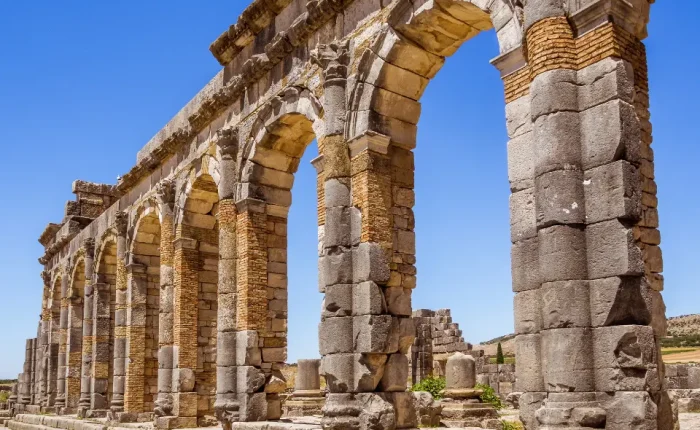
On the way to Meknes, we step back in time to explore one of Morocco’s most significant archaeological sites: Volubilis. These are the best-preserved Roman ruins in North Africa, showcasing ancient mosaics, temples, triumphal arches, and residential areas that give a vivid glimpse into life during the Roman Empire. Recognized as a UNESCO World Heritage Site in 1997, Volubilis offers a 45-minute guided tour that highlights its historical and architectural importance.
After exploring Volubilis, we continue toward Meknes, a city named after the Berber tribe Miknasa. Meknes was transformed into Morocco’s imperial capital under Sultan Moulay Ismail (1672–1727). His legacy is visible in the city’s grand architecture, including intricately designed barns with massive walls and small windows, originally built to store grain and hay for feeding horses and provisions for 15,000 inhabitants.
We also stop for photos at Bab El Mansour, the monumental gate constructed in the 11th century by King Al-Mansour Adahbi, renowned for its impressive design and elaborate decorations—a true symbol of Meknes’ imperial grandeur.
This day is a scenic journey across Morocco’s diverse landscapes, starting from the historic city of Meknes. The route takes us through Ifrane, often called “Little Switzerland” for its alpine-style architecture, lush greenery, and ski resorts in the Middle Atlas Mountains at an altitude of 1,665 meters. Ifrane is also home to the prestigious Al Akhawayn University, established in 1997 by King Hassan II of Morocco and King Fahd of Saudi Arabia, offering international education in English.
Lunch is planned in the Berber village of Midelt, located in the eastern High Atlas foothills, surrounded by striking mountain scenery. The journey continues across the rugged mountains inhabited by Berber communities, including views of palm oases near Jbel Ayachi (3,747 m). Descending toward the pre-Saharan zone, we pass Errachidia and Erfoud, renowned for pottery and fossil quarries. Erfoud’s fossils, dating back around 350 million years, hint at the area’s ancient oceanic past.
From the expansive plateau, the magnificent Erg Chebbi dunes of Merzouga rise on the horizon, passing through Rissani, the birthplace of the Alaouite dynasty where Moulay Ali Cherif began unifying Morocco in the early 17th century. The day concludes with dinner and an overnight stay at a hotel near the dunes.
In the morning, you explore the Erg Chebbi dunes, Morocco’s largest sand dunes, taking in the stunning desert landscapes. Along the way, you will pass nomadic black tents scattered across the sands and visit a nomadic family to enjoy traditional tea and learn about their way of life.
Next, you will discover the Touareg nomadic culture in Khamlia, a village where life has remained largely unchanged for centuries. Lunch can be enjoyed either in Khamlia or back at your hotel.
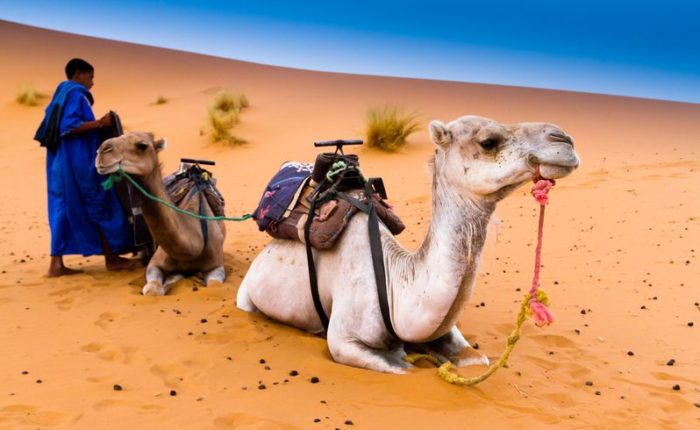
In the afternoon, embark on a camel ride into the heart of the dunes to witness a breathtaking sunset over Merzouga’s high dunes. Your evening concludes with an overnight stay in a Berber desert camp, offering an unforgettable view of the stars above the Sahara.
In the morning, visit Rissani, home to the mausoleum of the founder of the Alawite dynasty of Morocco. This historic town was the ancient capital of Tafilalet and a major crossroads for caravan trade between north and south. Today, Rissani remains an important commercial hub, with a lively souk on Tuesdays, Thursdays, and Sundays, historically famous for its leather and goatskin trade.
From Rissani, continue 127 km to the Todra Gorges, located beyond the central High Atlas Mountains. The dramatic landscapes here, with deep canyons, high plateaus, and peaks, are reminiscent of Colorado. Peaks such as Jbel Saghro (2,500 m) and Jbel Mgoun (4,068 m) dominate the region. Populated by Berber communities, the area offers an opportunity to walk through the stunning canyons and enjoy the unique natural beauty. Dinner and overnight stay are at a hotel nearby.
From the impressive Todra Gorges, we continue along the famous Road of 1000 Kasbahs, where massive kasbahs line both sides of the route. While some have been restored, many remain in ruins, showcasing the historic architecture of the region. A visit is scheduled at Kasbah Amarhidil, a beautifully preserved example of traditional Berber fortification.
The route passes through Boumalne, on the edge of the Dades Valley, an area rich in Berber agriculture. Along this journey, you’ll see the Valley of Roses, famous for its lush fields of alfalfa, olives, figs, and grapes. This valley produces roses used in local cosmetics, soaps, perfumes, and skin creams, celebrated annually in a national festival in late April.
Next, we drive to Ouarzazate, known as the Hollywood of Africa and a gateway to the desert. Located on a plateau south of the High Atlas Mountains, the city is inhabited mainly by Berbers who built the region’s iconic kasbahs. Notable sites include Taourirt Kasbah from the 17th century. Ouarzazate is famous for its film studios, hosting international productions such as Lawrence of Arabia, Gladiator, and Babel. Dinner and overnight are at a hotel in Ouarzazate.
Just 35 km from Ouarzazate lies the fortified Kasbah of Ait Ben Haddou, a striking example of 11th-century Moroccan architecture. This historic kasbah once served as a key stop along the ancient caravan route connecting the Sahara to Marrakech. Perched on a hill beside the Ounila River, it showcases beautiful kasbah structures, though many have been weathered by storms over the centuries. While most of the town’s inhabitants now live in a modern settlement across the river, about five families still reside within the kasbah, preserving its living heritage.
After exploring Ait Ben Haddou, the journey continues through the town of Taroudant, where guests will check in for overnight accommodation.
About 70 kilometers from Taroudant lies Agadir, the largest city of the Berbers and a modern hub on the Atlantic coast at the foot of the Atlas Mountains. Agadir hosts Morocco’s most important fishing and commercial port, ranking as the world’s leading sardine port and exporting commodities like cobalt, manganese, zinc, and citrus. The city is also a popular seaside resort with sandy beaches, modern hotels, wide avenues, European-style cafes, and lively markets, making it a dynamic and bustling coastal destination.
From Agadir, the journey continues along the Atlantic coast for nearly 200 km to Essaouira, a charming city known for its whitewashed houses with blue doors and windows, creating a picturesque seaside image. Founded in the 16th century and historically called Mogador by the Portuguese, its Berber name means “the wall,” reflecting the original fortress walls surrounding the city. Dinner and overnight stay will be at a hotel in Essaouira.
A full day of leisure in Essaouira allows you to explore this charming coastal city at your own pace. Essaouira is famous for kite surfing and windsurfing, thanks to its strong trade winds, and offers activities like horse and camel rides on the beach or quad biking for adventure lovers. The city is also known for its fresh and delicious seafood and is dotted with numerous art galleries showcasing local creativity.
Essaouira hosts the Gnaoua World Music Festival each year in late June, attracting artists from around the globe and blending traditional Gnaoua music with rock, jazz, and reggae. For film enthusiasts, the city has a square named after Orson Welles, who shot his movie Othello here in 1952. Alternatively, you can simply spend the day relaxing at your hotel, enjoying the coastal atmosphere.
On the journey from Essaouira to Marrakech, you will pass through areas dotted with majestic argan trees, often seen climbed by goats. These trees produce the famous argan oil, traditionally used in cooking, for skincare remedies, and now widely used in cosmetics. A visit to a local women’s cooperative provides a fascinating insight into the traditional method of hand-pressing argan fruits to extract this precious oil.
After this cultural stop, you will arrive at your hotel in Marrakech, with the opportunity for a short evening walk if time allows, enjoying the vibrant atmosphere of the city.
In the morning, enjoy a full guided tour of Marrakech, famously called the “Red City.” This imperial city lies near the Atlas Mountains and combines the ancient Medina with the modern district of Gueliz, built during the French protectorate.
Explore the bustling Djemaa el Fna square, alive with storytellers, dancers, musicians, water sellers, and snake charmers, which transforms at night into a vibrant open-air restaurant. Visit the historic Koutoubia Mosque from the 12th century and wander the narrow streets and alleys of the old city, passing by the tombs of the Seven Saints, relocated during Moulay Ismail’s reign to attract pilgrims. Return to the hotel for dinner and overnight stay.
After completing the guided tour, you will have free time to explore Marrakech on your own. Wander through the medina’s winding streets, visit local markets and shops around Djemaa el Fna, or enjoy the traditional Moroccan amenities at your hotel to relax and soak in the last evening of your trip.
A private transfer will take you from Marrakech to Casablanca Mohammed V Airport, scheduled according to your flight details.
WhatsApp us